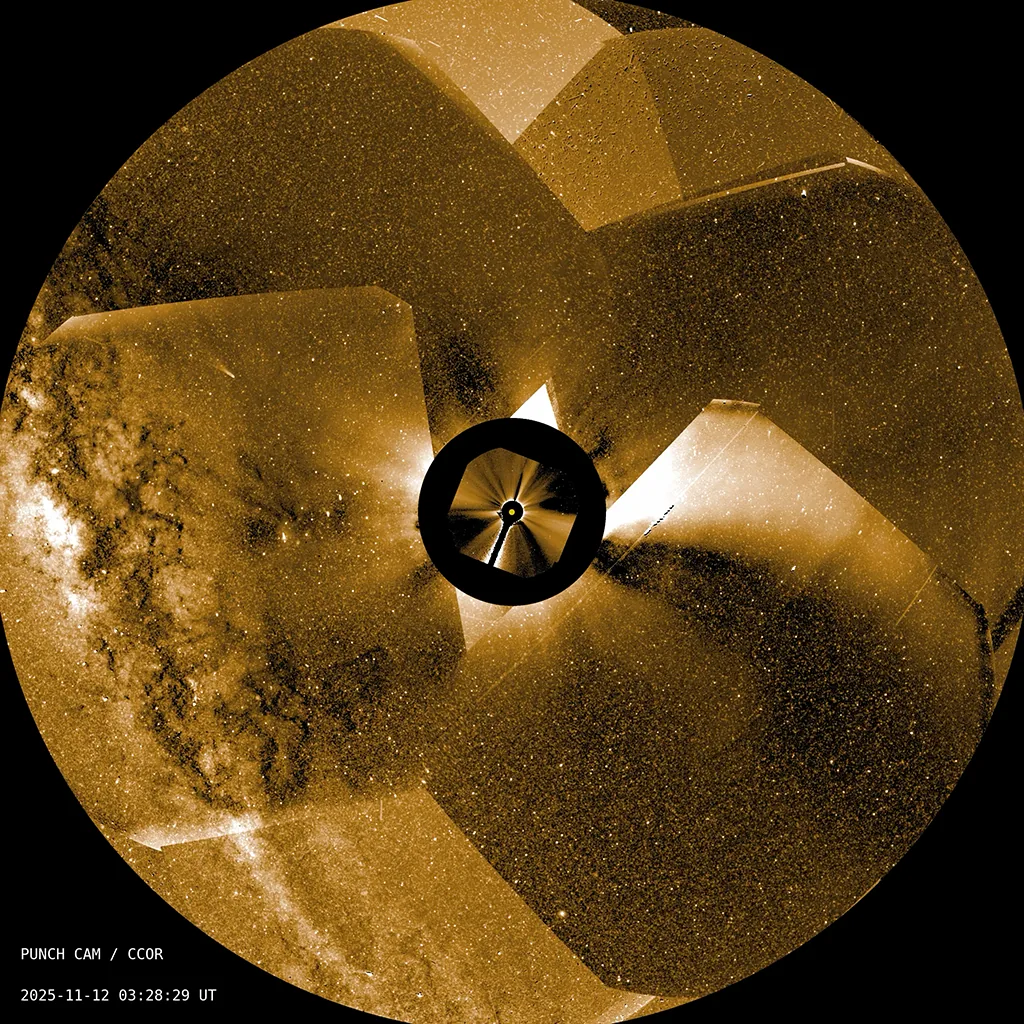
A first forecasting test using NASA's PUNCH mission estimated the arrival of a solar eruption near Earth to within 30 minutes. The result suggests that continuously watching material travel through the inner solar system could eventually improve warnings for disruptive space weather, but the exercise involved one past event and is not yet an operational forecasting system.
PUNCH, short for Polarimeter to Unify the Corona and Heliosphere, uses four small spacecraft in low Earth orbit. Their combined view is designed to follow the Sun's faint outer atmosphere and the solar wind as one connected system. NASA says earlier instruments generally lost sight of coronal mass ejections after roughly the first fifth of their journey toward Earth.
For the test, researchers revisited a coronal mass ejection that left the Sun on May 31, 2025. They fed images of its leading edge into a model that estimated the cloud's speed, changing shape and expected arrival time. About 12 hours after the eruption began, the model settled on a prediction that the storm would reach Earth eight hours later. The actual arrival occurred within half an hour of that estimate.
NASA compared the result with methods that typically provide an arrival window of about five hours, making the experimental estimate roughly ten times narrower. The model also indicated when its prediction had stabilized, information that could help a forecaster judge whether an estimate was ready to use.
The practical stakes include satellites, power systems, communications and astronaut safety. Coronal mass ejections carry magnetized plasma that can disturb Earth's magnetic environment, although severity depends on more than arrival time. Direction, magnetic orientation and internal structure also matter.
The findings were presented at the Committee on Space Research Scientific Meeting and were still under journal review when NASA announced them. More events, refined calibration and testing in real forecasting conditions will be required before the approach can be judged against operational systems.